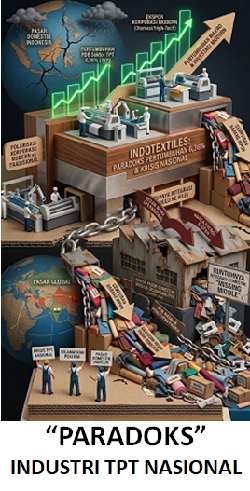


Head of Public Policy DPB Indonesian Employers Association (Apindo) Danang Girindrawardana responded to news of mass layoffs (PHK) in the textile industry sector. He admitted that he had not been able to describe the total number of employees affected by the layoffs. "We are still waiting for data on the number (of employees affected by layoffs) from Apindo members and related associations," said Danang via short message on Monday, October 31, 2022. Previously, the Department of Manpower and Transmigration of West Java Province revealed that around 43,000 textile and garment workers in six regencies in West Java experienced layoffs.
This condition occurred because of the impact of the Covid-19 pandemic and the Russia-Ukraine conflict which made the garment and textile product markets, namely Europe and America, experience a crisis.
Chairman of the Indonesian Textile Association (API) Jemmy Kartiwa Sastraatmadja also predicted that mass layoffs would occur in the textile industry sector. These signs are reflected in the decline in exports which reached 30 percent in October 2022.
The export disruption resulted in a sharp decline in the utilization of the textile industry, resulting in a reduction in working hours. "Finally there was termination of employment," said Jemmy on Thursday, October 27, 2022.
He explained that the decline in exports of the textile industry occurred in line with the weakening of purchasing power in the United States and Europe. The two regions are still the biggest textile export destinations for Indonesia. The threat of a 2023 recession has made business players predict a continued decline in exports. Along with that, the threat of a wave of layoffs lurks next year.
Business actors see the cause of the decline in exports as weakening purchasing power in the United States and Europe. This condition has forced other textile product producing countries, such as China, Bangladesh, Vietnam, and India, to invade the Indonesian market. As a result, there is competition between domestic production and imports.
"On the one hand, export demand has decreased, on the other hand, the domestic market has been flooded with imported products," he said. Therefore, Jemmy hopes that the government can maintain the domestic market to make it more profitable for Indonesian producers.
Moreover, he said, Indonesia is considered capable of surviving in the midst of the global economic darkness due to the 2023 recession and has the fourth largest population in the world. Indonesia's inflation is also predicted not to rise too high.
Secretary General of the Ministry of Manpower, Anwar Sanusi, hopes that employers will not implement layoffs in the midst of the current sluggish global economy. Even so, Anwar admits, the layoff route is the last resort for the textile industry in responding to the crisis.
"Hopefully the last route will not be taken, this is what we hope for. We have a bipartite dialogue, if we meet a dead end we will hold a tripartite dialogue," said Anwar at the Jakarta Convention Center, Sunday, October 30, 2022.
According to Anwar, the issue of layoffs can be avoided by means of communication or deliberation between employers as employers and the workers themselves. In the dialogue that exists between parties, employers and employees can not only solve problems at the bipartite stage.
But it can also reach the tripartite stage by involving the government as a third party. "We convey that layoffs are the final solution, in this case the Ministry of Manpower through the Directorate General of Industrial Relations (PHI) we mediate," said Anwar.