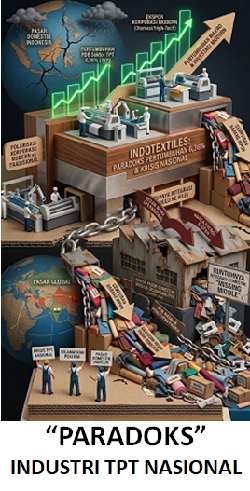


The weakening of the rupiah against the United States (US) dollar has had an impact on the textile and textile products (TPT) industry. Primarily, the impact is felt downstream in the form of finished goods. General Chair of the Association of Fiber and Filament Yarn Producers (APSyFI) Redma Gita Wirawasta said that currently its influence is starting to be felt in the textile industry, especially for domestic sales. "This is already starting to be felt, especially for domestic sales which use rupiah. Many of our customers are burdened by the exchange rate which is close to IDR 16,000," said Redma, Tuesday (24/10/2023).
Redma explained that in his own association the price of raw materials does not have much influence because there is permission from Bank Indonesia (BI) so that raw material transactions can be carried out in US$ units. Likewise, sales are still allowed in US$.
"The problem is in our downstream area. Because currently the majority of domestic sales use rupiah. So they sell rupiah but buy the raw materials using US$," he explained.
The General Chairperson of Indonesian Textiles (API) Jemmy Kartiwa also conveyed a similar thing. The impact of the high dollar exchange rate against the rupiah has begun to be felt. However, the impact is not very significant.
"There is an impact of the weakening of the rupiah, although it is not as big as the weakening of the stock market," he said.
According to him, components in the textile industry that are affected by the value of the US dollar are estimated to account for around 60%. However, according to him, the main problem causing the utilization of the textile industry to fall is the result of the market being flooded with imported products.
"The main problem is the reduction in orders from both the export and local markets due to the weakening export market. All TPT producers such as China are trying to find or enlarge their markets. One of the targets is the Indonesian market," said Jemmy.
On the other hand, the impact of the weakening value of the rupiah has begun to be felt by a number of Tanah Abang Market traders. One of them is Siska, the shop head of a suit shop in Tanah Abang Market Block B. He admitted that he had increased the price of his products by 5-10% because the price of raw materials for his suits which were taken from China had risen by up to 30%.
"It's already about 30% of the previous price of raw materials. So the price will increase at most. The increase won't be much, at most around 5-10%," said Siska, at Tanah Abang Market Block B, Central Jakarta, Tuesday (24/10/ 2023).
Rafi, a women's clothing trader at Tanah Abang Market Block B, felt the same thing. He was forced to increase the selling price of his cargo pants product because the price of raw materials rose. From initially IDR 65 thousand, now the price has reached the range of IDR 75-80 thousand.
"People say convection increases (fabric raw materials). For example, if it's IDR 50 thousand, it increases to IDR 55 thousand. Around 10%. So it's more expensive to buy," said Rafi, when met separately.
This step made a number of customers complain about the price increase. In fact, the number of buyers has now dropped drastically by half. The deserted Tanah Abang Market, coupled with the increase in raw material prices, has meant that income has greatly reduced.