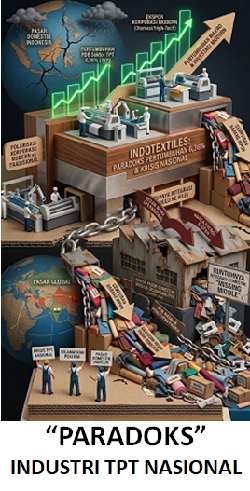


The textile and textile product (TPT) industry is now overshadowed by the pressure of increasing cargo rates which has an impact on weakening competitiveness compared to other countries.
Chairman of the Indonesian Textile Association (API) Jemmy Kartiwa revealed that the increase in cargo rates had occurred since the third quarter of 2020. Meanwhile, currently it is considered to be the peak of the increase in cargo rates because the increase has now reached 5 to 6 times the normal rate.
"Tariffs for cargo or containers that continue to rise greatly affect the competitiveness of Indonesian products," said Jemmy.
Jemmy added that the increase in cargo rates was exacerbated by Indonesia's geographical location which was less favorable than competing countries such as China, India and Vietnam. These countries are closer in distance to a number of export destinations such as the United States (US), the European Union, and Latin America.
Jemmy gave an illustration, under normal conditions, the tariff for cargo from Indonesia to the US is US$ 2,500 per container. With the increase in tariffs, now the costs that must be reached can even reach US $ 18,000 per container. Meanwhile, competing countries such as India in normal conditions spend US$ 1,500 per container, with an increase in cost rates of only US$ 7,500 per container.
"So (the increase in tariffs) makes the difference widen," explained Jemmy.
In the midst of these conditions, buyers generally want the price of the product to the destination country from each country to have the same amount. As a result, buyers bid for Indonesian products cheaper than India. Not to mention, products from India reach the export destination country faster.
In this condition, business actors expect a number of policies to maintain the continuity of the textile industry. Jemmy said there needs to be protection for unfair trade practices. Moreover, according to Jemmy, this step has already been initiated by the government through the Ministry of Trade and the Ministry of Industry.
"We also hope that the PMK safeguards for apparel will be immediately published by the Ministry of Finance," said Jemmy. The presence of a number of these policies is also considered to have a positive impact on Small and Medium Industries (IKM) and related industries above it.
Jemmy revealed that domestic IKM business actors are now overshadowed by the pressure of imported products. According to him, there needs to be a strengthening of market protection rather than providing capital considering that unfair trade practices still occur.
"If the capital is given but the market is not there, it's useless. The capital actually runs out and causes bad loans," explained Jemmy. He gave an example, recently imported hijab products have entered Indonesia, even though similar products are also produced by domestic SMEs.
For that, it is necessary to protect the domestic market. If later access to the domestic market is strengthened, business actors can start exploring export market opportunities.
"In their country, they are trained first in terms of quality, fashion and speed of supply as well as following fast fashion fashions that almost occur all over the world," concluded Jemmy.