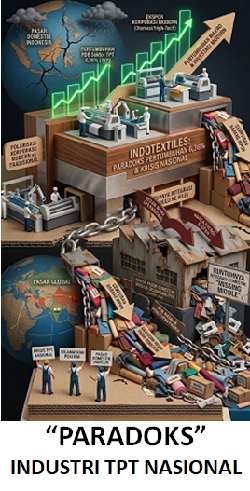


Based on data from the Ministry of Industry (Kemenperin), TPT grew to 12.5 in the first quarter of 2022. This achievement is quite significant because in 2020 and 2021 it was 13 percent and 8 percent. Secretary General of the Ministry of Industry, Dody Widodo, explained that the textile industry is still making a big contribution to the Indonesian economy. This sector can even be called the pillar of the Indonesian economy. "This industry is still a mainstay, because it is one of the backbones (of the economy) and also absorbs a lot of manpower," said Dody at the ITT-STT-Polytechnic College of Textile Technology alumni gathering, Sunday (17/7).
According to him, the Indonesian textile industry is currently facing challenges from many competitors from a number of neighboring countries. Moreover, products from abroad began to flood the domestic market with lower prices.
Therefore, education and industry players must jointly develop themselves to answer these challenges. Thus, domestic textile products can compete in price.
"The world of education such as the STTT Polytechnic in Bandung should be a stepping stone in the future entering the 4.0 era in the textile industry. The better the resources, the better the industry," he said.
"With Indonesia's population of over 250 million people, the domestic textile industry can still develop and meet the needs of the textile sector independently, as well as export to many countries," he continued.
On the same occasion, the Director of the Textile, Leather and Footwear Industry of the Ministry of Industry, Elis Masitoh, revealed that the industry currently has contributed to the gross domestic product (GDP) reaching 6.35 percent.
In nominal terms, the export value of the textile industry is equivalent to 13 billion US dollars with a total workforce of approximately 3.56 million people in all industries. Elis believes that the textile industry is one of the biggest contributors to the Indonesian economy.
"In line with 100 years of textile education, hopefully in 2030 the export value can increase to 20 billion US dollars and even 30 billion US dollars," said Elis.
In addition, the Ministry of Industry targets that there are 5 to 6 million workers that can be absorbed by the textile industry. However, it requires cooperation from policy makers from the community, educational institutions, to the research and development sector.
Director of the Polytechnic College of Textile Technology (STTT), Tina Martina added, her party continues to produce superior human resources (HR). This is in line with the government's determination to create a workforce that is ready to compete in the textile industry.
"That's why we have a target to prepare international accreditation. That's how we prepare the best graduates from campus," he said.
Meanwhile, Chair of the ITT-STTT-Polytechnic STTT Grand Reunion, Haris Sugondo, explained that all university graduates will be gathered in a reunion event which will be held on July 30, 2022. This gathering can also be used to exchange ideas about the textile industry.
"We must support the determination of the Ministry of Industry so that the textile industry can become the backbone of the Indonesian economy," said Haris.
That way, Haris invites all alumni to attend the grand reunion activity. It is planned that the event will be attended by around 1,500 to 2,000 alumni or around 50 batches